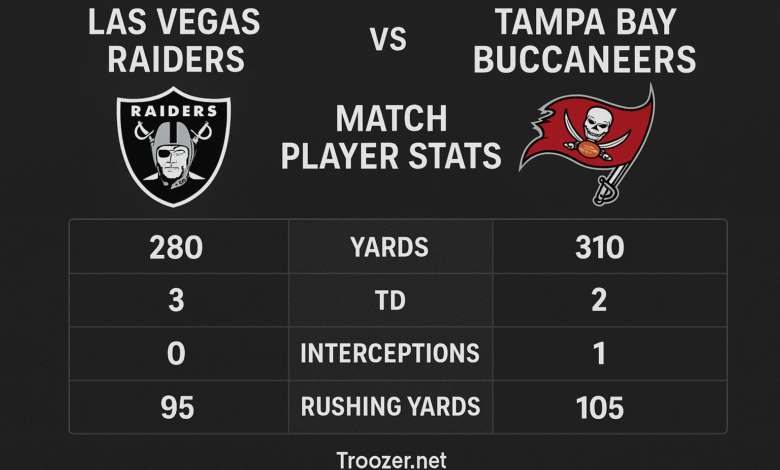
The Las Vegas Raiders vs Tampa Bay Buccaneers match player stats have long been a fascinating topic for football analysts and fans who enjoy comparing two franchises with different philosophies, histories, and roster evolutions. Although the teams are not traditional rivals, their matchups—whether regular-season meetings, preseason showdowns, or playoff-level historical moments—often provide a compelling contrast in play styles. The Raiders, known for their aggressive, big-play identity, frequently clash stylistically with the Buccaneers, who have traditionally leaned on structured defense and balanced offensive systems.
Understanding these matchups requires more than looking at final scores. Instead, analyzing the player stats gives a clearer picture of how individual performances, positional battles, and tactical decisions shape the game. Whether the focus is on quarterbacks, running backs, wide receivers, pass rushers, or defensive backs, each statistical category contributes to the broader narrative of how these teams challenge one another on the field.
Quarterback Performance: The Centerpiece of the Matchup
Quarterback statistics often define the tone in any Raider–Buccaneer meeting. Historically, Raiders quarterbacks tend to lean on vertical passing concepts, often accumulating higher yards per attempt when the offensive line holds strong. Typical Raiders QB match player stats in such matchups include:
-
High passing attempts when trailing or facing Tampa Bay’s pressure defense
-
Deep-ball completions to stretch the secondary
-
Turnover risks, especially against disciplined Bucs linebackers
On the Buccaneers’ side, their quarterbacks historically reflect more controlled, system-driven efficiency. A typical Buccaneers QB statistical profile includes:
-
Intermediate accuracy, utilizing tight ends and slot receivers
-
Lower sack rates in games where the offensive scheme mitigates pressure
-
Red-zone efficiency, an area where the Bucs often excel
When comparing the two, the stats frequently reveal a clash between explosiveness and efficiency—one that often determines which offense ultimately takes control.
Running Game: A Battle of Physicality and Clock Control
The running backs in a Las Vegas Raiders vs Tampa Bay Buccaneers match often face different defensive philosophies.
Raiders Running Back Stats Tend to Show:
-
Emphasis on inside zone and power runs
-
Yards after contact, reflecting tough, physical running styles
-
Usage in short-yardage situations and red-zone touches
Buccaneers Running Back Stats Typically Reflect:
-
Balanced run-pass involvement, often with receiving targets
-
Outside zone and sweep plays to utilize speed
-
Consistent early-down carries to establish offensive rhythm
In most matchups, the Bucs’ ground stats demonstrate versatility, while the Raiders often lean on strength and downhill momentum. These differences can lead to contrasting time-of-possession stats, which significantly influence game outcomes.
Wide Receiver and Tight End Stats: The Playmakers Who Shift Momentum
Skill positions often deliver the most memorable performances in Raiders–Bucs matchups.
Raiders Receiving Corps Statistical Trends
Las Vegas receivers—historically built around speed—often record:
-
High yards per reception
-
Deep target shares from vertical routes
-
Explosive plays that change momentum
Raiders tight ends also contribute meaningfully, frequently showing:
-
Strong red-zone efficiency
-
High catch rates on play-action passes
Buccaneers Receiving Corps Statistical Trends
Tampa Bay’s receivers generally produce:
-
High reception totals, built from timing-based routes
-
Significant yards after catch from slants and crossers
-
Balanced distribution across WR1, WR2, slot receivers, and tight ends
Tight ends often play a bigger role for the Buccaneers, especially in games where they attack mismatches against linebacker coverage. As a result, Tampa Bay tight ends often show high target counts and critical third-down conversions.
Defensive Stats: Where the Matchup Becomes Truly Intriguing
Defense ultimately dictates which offensive stats stand out. Both franchises have developed strong defensive traditions, though in different ways.
Raiders Defensive Stat Patterns
The Las Vegas defense tends to emphasize:
-
Pass-rush production, often recording notable QB pressures
-
Man-coverage matchups, leading to pass breakups or explosive plays allowed
-
Turnover attempts, with strip-sack and interception opportunities
Buccaneers Defensive Stat Patterns
The Tampa Bay defense is often defined by:
-
Elite linebacker tackle totals
-
Aggressive blitz percentages, aiming to disrupt QB rhythm
-
Strong run-stopping numbers, limiting opposing RB yardage
In many matchups, the defensive stats reveal that Tampa Bay’s linebackers and defensive line play a major role in neutralizing Raiders’ big-play potential, while the Raiders’ edge rushers focus heavily on generating sacks to slow the Bucs’ offensive efficiency.
Special Teams and X-Factors in the Stat Sheet
Special teams statistics often tip close games. Field-goal accuracy, average punt distance, return yardage, and hidden yardage gained from field position become crucial in cross-conference matchups.
Both teams traditionally rely on:
-
High-powered punters to flip the field
-
Reliable kickers in cold or windy stadium conditions
-
Speedy returners capable of generating momentum-shifting plays
While less glamorous, these stats commonly reveal which team maintains composure in high-pressure moments.
Conclusion
When analyzing Las Vegas Raiders vs Tampa Bay Buccaneers match player stats, it becomes clear that the contrast between these two franchises creates a compelling statistical narrative. The Raiders bring explosive offensive tendencies and dynamic pass rushing, while the Buccaneers respond with balanced offense, structured defense, and strong fundamental play.
By examining quarterback performance, rushing efficiency, receiving impact, defensive production, and special teams execution, fans and analysts gain a deeper understanding of how each aspect of the game contributes to the final outcome. Even when the scoreline tells only part of the story, the detailed player stats reveal the true chess match unfolding on the field—one built on tactics, athleticism, and the unique identities of the Raiders and Buccaneers.